How Solar Works for Homeowners
A plain-English, basic explanation of solar panels, batteries, utility bills, and what determines whether solar actually makes sense for your home.
How Solar Works for Homeowners
A plain-English, basic explanation of solar panels, batteries, utility bills, and what determines whether solar actually makes sense for your home.
The Simple Explanation
Solar Power in 60 Seconds
Solar energy works by converting sunlight into electricity using panels installed on your roof or property.
During the day, your solar system produces electricity that powers your home first.
If your system produces more electricity than you use at that moment, the excess may be sent to the grid or stored in a battery, depending on how your system is designed.
At night or when solar production is low, your home draws electricity from either:
The grid
A battery system
Or a combination of both
The goal of a well-designed solar system is to reduce your dependence on utility electricity while keeping your home reliably powered.
Most homeowners hesitate to go solar for a simple reason:
The information is confusing, and the sales pressure is real.
At Upstart Energy, we take a different approach.
We start with education so you can clearly understand how solar, batteries, and the grid actually work — and then help you implement the right system for your home through our solar platform partner, Powur PBC, when the time is right.
The Four Main Parts of a Solar System
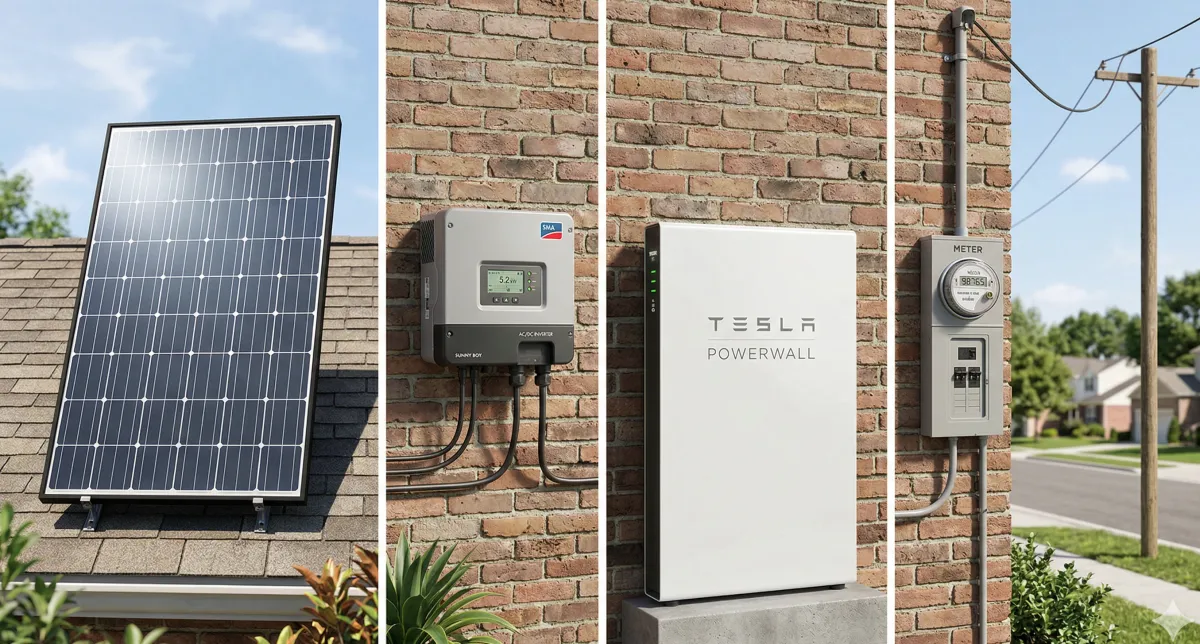
Solar Panels
Solar panels capture sunlight and convert it into electricity.
They are typically installed on the roof where they receive the most sun.
Panels are very durable and commonly carry 25-year performance warranties.
Inverter
Solar panels produce direct current (DC) electricity.
Homes use alternating current (AC) electricity.
The inverter converts solar electricity into usable power for your home.
Battery (Optional, but becoming less so)
A battery stores extra solar energy produced during the day.
This stored energy can be used:
At night
During outages
During expensive utility rate periods
Battery adoption is increasing quickly as homeowners seek energy independence and backup power.
Utility Grid
Most homes remain connected to the grid.
This connection provides electricity when solar production is low and allows excess energy to be exported depending on your local utility rules.
What Happens to Solar During the Day

Typical Daily Energy Flow
Morning
Solar production begins and starts powering your home.
Midday
Your system often produces more electricity than your home needs. This excess energy is either stored in your battery or sent back to the grid.
Afternoon / Evening
Solar production declines and your home begins using battery or grid electricity.
Night
Your home runs on stored battery energy or the grid.
A well-designed system balances these flows to maximize savings and reliability.
Why Utility Policies Matter
Solar does not operate the same way everywhere:
How excess solar electricity is credited
How electricity rates change during the day
How batteries interact with the grid
This is why solar systems must be designed specifically for each location and homeowner.
Two homes on the same street may benefit from different system designs.
What Determines Whether Solar Makes Sense
Solar is not simply about putting panels on a roof.
Several factors determine whether solar will benefit a homeowner.
Electricity Rates
Higher electricity costs generally increase the potential benefit of solar.
Sun Exposure
Roof direction, shading, and local climate affect solar production.
Utility Policies
Net metering and time-of-use rates strongly influence system economics.
Battery Strategy
Battery storage can improve resilience and help manage changing utility rate structures.
Rebate Programs
Battery costs can be offset by utility, local, state and federal rebate programs, making storage systems more affordable and practical for every homeowner.
Common Solar Misconceptions
“Solar eliminates my electric bill.”
Solar reduces reliance on the grid, but most homes remain grid-connected.
Utility charges may still apply depending on local policies.
“All solar systems are the same.”
System design matters.
Panel placement, inverter technology, battery sizing, and utility rules all influence performance,
“Batteries are only for outages.”
Batteries can also reduce electricity costs by shifting when energy is used.
“Solar doesn't work when it's cloudy”
Solar panels actually still generate power on cloudy days by capturing diffuse sunlight that filters through the overcast sky.
They may be less efficient than in direct sun, but high-quality systems paired with a battery ensure you have a steady stream of energy regardless of the weather.
Why Many Homeowners Seek Independent Guidance
Many solar installations are sold through traditional sales models where homeowners receive limited education before making a major decision.
Homeowners generally seek a different approach:
First, understand how solar actually works
Then, evaluate whether solar makes sense for their situation
Finally, receive a design for a system that fits their goals
The objective is clarity first, installation second.
Learn More With the Solar Planning Guide
If you are considering solar, a helpful next step is reviewing a state-specific solar planning guide that explains local utility policies, incentives, and system considerations.
Download the Solar Planning Guide for your state.
Want to Evaluate Solar for Your Home?
If you’d like to understand whether solar and battery backup make sense for your situation, you can schedule a Solar Clarity Call.
During this call we review:
Your current and future electricity usage
Your utility rate structure
Solar and battery options available in your area
Financial options, including $0 down programs.
The goal is simple: clear information so you can make an informed decision.

Providing independent solar education and guidance so you can evaluate solar and battery storage with confidence
Navigation
Home
Solar Education
Guides
What Others Are Saying
Clarity Call
Contact
Email: hello at upstartenergy.com
Phone: (707) 413-0044
© 2026 ALL RIGHTS RESERVED
Head Office: 5812 W Norwich Ave, Fresno, CA 93722