Solar Financing Options Explained: Prepaid Leases vs Ownership
Before You Choose Solar Financing, it Helps to Understand What’s Changing
If you’ve been looking into solar recently, something probably feels… different.
Not necessarily better. Not necessarily worse.
Just different.
And if you can’t quite put your finger on why, you’re not alone.
A big part of what’s changing right now isn’t the technology.
It’s how solar is being financed.
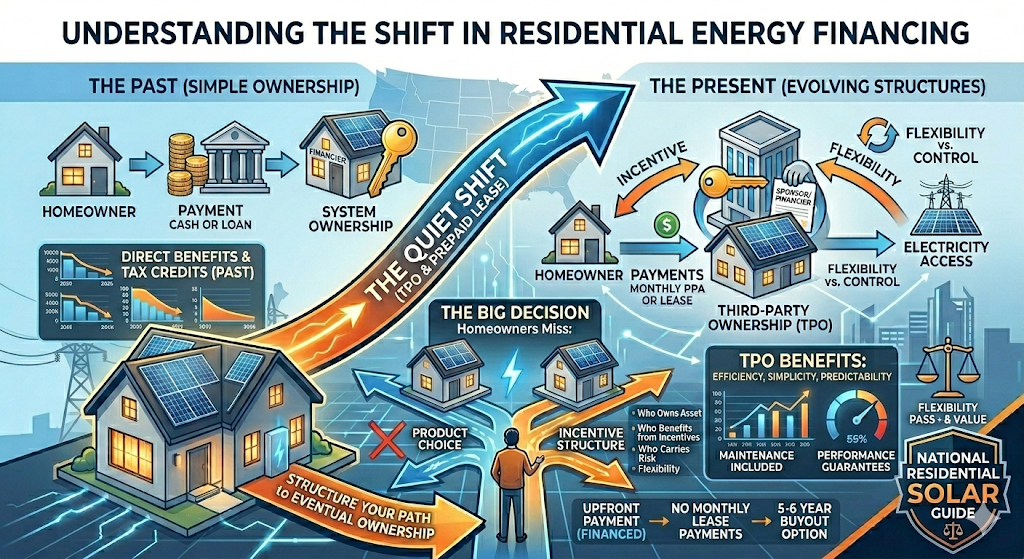
The Quiet Shift Toward Third-Party Ownership:
For years, homeowners had a relatively straightforward choice:
Pay cash
Take out a loan
Or lease the system
Now, that landscape is shifting.
With the expiration of the residential federal tax credit, more of the market is moving toward what’s called third-party ownership (TPO) — where you don’t own the system initially.
Instead, a company owns the system on your roof, and you either:
Pay for the electricity it produces (PPA), or
Pay for access to the system (lease)
This isn’t new.
What is new is how these models are evolving.
Enter: The Prepaid Lease (A Hybrid Approach):
One of the newer options gaining traction is something called a prepaid lease.
At a glance, it sounds simple:
You pay upfront (or finance that upfront payment)
You avoid monthly payments
You may have the option to buy the system later — often in 5–6 years
In theory, it bridges the gap between leasing and owning.
And for some homeowners, that can make sense.
But like most things in solar… the details matter.
What This Actually Solves (and What It Doesn’t):
A prepaid lease can reduce monthly complexity.
It can create a clearer path to ownership.
And it can allow access to incentives that might not otherwise apply.
But it also introduces a different kind of decision:
You’re committing upfront before fully experiencing how the system performs on your home.
That’s not inherently good or bad.
It just means the decision requires greater clarity.
Because once you’ve prepaid, your leverage in the relationship may change—especially if performance doesn’t meet expectations.
The Part Most Homeowners Miss:
The biggest misconception I see right now is this:
People think they’re choosing between products.
They’re not.
They’re choosing between ownership structures.
And those structures determine:
Who owns the asset
Who benefits from incentives
Who carries the risk
And how flexible your future options are
That’s why two systems that look identical on paper can behave very differently over time.
A New Option Worth Knowing About:
There’s also a newer variation emerging that’s worth being aware of.
Some providers — including platforms like Powur, working with partners such as Concert Finance — are beginning to offer prepaid lease structures paired with financing options.
In simple terms, this can allow homeowners to:
Finance the upfront prepaid amount
Avoid traditional monthly lease payments
And still retain a structured path toward eventual ownership
It’s early.
And like all new financial products, the specifics matter.
But it’s another example of how quickly this space is evolving — and why understanding the structure matters more than ever.
Where This Leaves You as a Homeowner:
If all of this feels a bit complex, that’s not a reflection of you.
It’s a reflection of the market.
As solar matures, the financing is becoming more sophisticated — not simpler.
Which means the real question isn’t:
> “Should I lease, finance, or prepay?”
It’s:
> “What problem am I actually trying to solve?”
Because depending on your answer, the “right” structure can look very different.
If your goal is the lowest upfront cost → one path
If your goal is long-term ownership → another
If your goal is flexibility → something else entirely
A More Useful Way to Think About It:
Before evaluating any proposal — prepaid lease or otherwise — it helps to get clear on a few things:
How much control do you want over your energy?
How long do you plan to stay in your home?
How important is ownership vs. simplicity?
How comfortable are you with long-term agreements?
Those answers matter more than the label on the financing.
Final Thought:
Prepaid leases aren’t “good” or “bad.”
They’re simply another tool.
And like any tool, they work well in some situations — and not in others.
The key is understanding what you’re actually agreeing to… before you decide.
---
If you want a clearer picture of how solar, batteries, and different financing structures actually work together, our solar planning guide walks through it in plain English.
No pressure. Just clarity.
Source: Billy Ludt, Solar Power World, April 16, 2026 — “Prepaid leases provide pathway to home-owned solar projects.”